

Millennials have a "credentialed class" problem.
Why the woman who copied my content deserved to go viral.
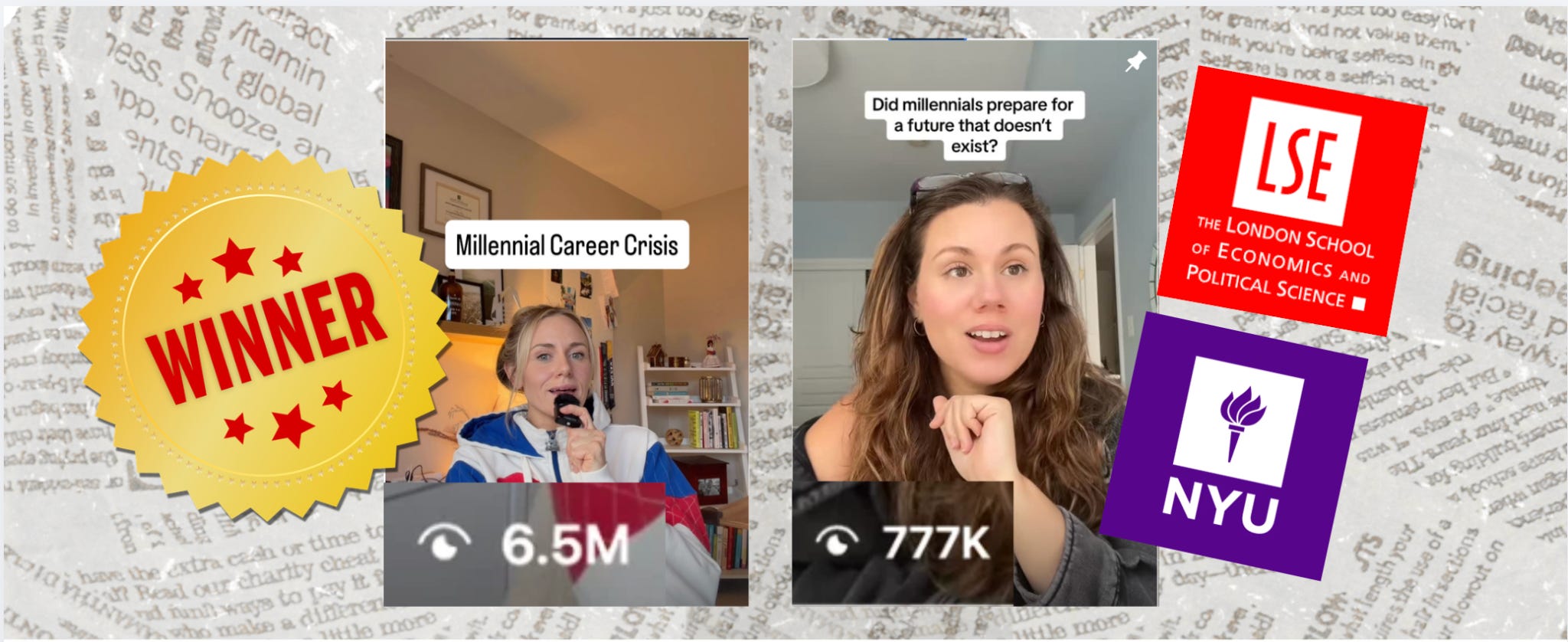
A few months ago, a video went viral like a creator’s wet dream: hundreds of thousands of views within hours, the whole comments section on fire, skyrocketing from 10k followers to 100k followers in a matter of days.
The creator was making a point about modern careers that I have, on the record, made many, many times — in newsletters, on podcasts, in talks I’ve been paid to give, you get it. Well, she wasn’t really “making a point” so much as regurgitating my exact words and original phrasing to describe the Great Millennial Career Crisis…
Same exact words, slightly different delivery, and a ~6M difference in views between our videos. Fuck.
Uncomfortable admission #1: Once her video started taking off, countless friends and peers of mine tried to console or commiserate with me using a similar refrain: “She doesn’t even talk about careers, so she can’t really go any further from here! You’re the one who’s studied career development for a decade!”
Up to the point of posting her Great Millennial Career Crisis video, she was a nutrition coach turned furniture flipper, that was her whole thing. She’s openly career confused, she doesn’t (to my knowledge) have a degree in organizational psychology or a thesis on career development. I do. And nobody cared.
Uncomfortable admission #2: My first reaction was the obvious one: “But I’m more qualified to say this!”
My second reaction, a few days later, was the more painful one: “So what?” The “right” qualifications were never what made her message hit for millions of people. It was her delivery and her timing.
The fact that she said what I’d been saying, but in a way that made people feel something and respond so passionately, without the academic foundation I keep instinctively leaning on, is what’s made her content creation journey so successful in such a short time.
And the most uncomfortable admission of all: She isn’t disqualified from being a compelling voice in this space just because she didn’t study it the way I did. In fact, for 300,000 people, that’s exactly what makes her compelling.
I have two degrees in work psychology. She has a furniture-flipping studio in her garage. The market chose her.
What most millennials still aren’t accepting is this: the competitive advantages we banked on aren’t competitive advantages anymore. Here’s what I mean:
We were raised on a very specific deal: do well in school, get into a good college, get into an even better grad school, build a resume of recognizable names, accumulate the right credentials, and the gate would open for us. Because the world we were preparing for was a gatekept one. The alumni network mattered because you needed a warm intro to get a real interview. The degree mattered because it was the filter that recruiters used to weed through a stack of resumes.
Every single one of those advantages was real up until 2020.
Today? If you can write a compelling cold email, you don’t need the alumni network.
If you can spin up a website and sales funnel in an afternoon, you don’t need the venture-friendly Stanford MBA pipeline to start a company that makes real money.
If you can build an engaged audience on the internet, you don’t need the gatekeepers at all. In fact, you can become the gatekeeper.
The “success infrastructure” that used to require credentials, capital, and connections now requires a Wi-Fi connection and a willingness to feel stupid online for 18 months.
Millennials trained for survival of the most-decorated. The new reality is survival of the scrappiest, but a lot of millennials still aren’t willing to take that ego hit.

What Gen Z is getting right
Here’s the part that should genuinely rattle the millennial “credentialed class,” as I’m calling it.
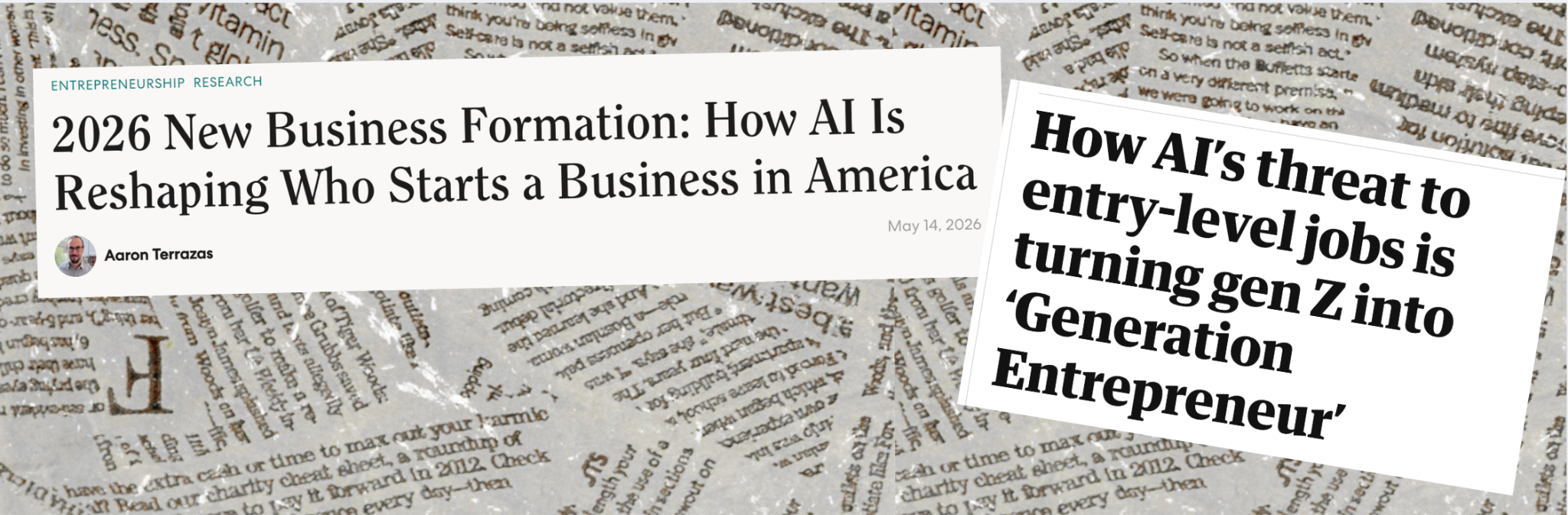
A new Gusto report dropped this week revealing that, for the first time in history, Gen Z has surpassed Boomers in new business starts. Seventy-one percent of Gen Z founders used AI to launch their businesses.
The Guardian recently profiled a wave of Gen Z grads who saw at the disappearing entry-level opportunities and AI obliterating the bottom of the corporate ladder and just went around the whole system.
ZipRecruiter found that nearly 38% of recent grads are considering starting their own business instead of looking for a traditional job (not “in addition to”).
I keep seeing older generations’ commentary frame this as “Gen Z is getting eaten alive by AI.” But that’s our all-or-nothing, meritocracy-trained read on it.
I think the more honest read is: Gen Z isn’t fighting our fight. Whereas millennials and the generations above us feel like we’re the savvy ones trying to outsmart the system, Gen Z just aren’t entering the system in the first place.
This is what made the copied-content moment so destabilizing for someone like me. I was still banking on the “rule” that credentials should matter in who gets attention and recognition for something, and that earning “legitimacy” through the “proper channels” is the precondition for being heard. (I’m done with the air quotes now, sorry).
The reason I felt that flash of resentment watching her videos go viral and her audience growth skyrocket wasn’t really about her, it was about me. It was the sobering realization that the old competitive advantages that I’d felt so proud of (pedigree, depth, logos on my resume, the years of work I’d put in to be qualified to say things) aren’t necessarily competitive advantages anymore, at least not in the space we’re both playing in, content.

What I’m not willing to discard
The easy version of this essay would be to declare credentials dead and tell you to start an Amazon drop-shipping operation for whatever products currently have the highest margins. I’m not doing that.
There are things I genuinely still believe in, like intellectual integrity, business integrity, the discipline of saying “I don’t actually know that yet” instead of confidently selling a framework you made up on the toilet.
Just because you can spin up a sales funnel for a coaching program you have no business running doesn’t mean you should. The democratization of tools means the democratization of grift, too.
Uncomfortable admission #3: I don’t think integrity is a competitive advantage in the short term. I want to be honest about that. The supplement bros are winning right now, from an income standpoint at least. The “vibey” business coaches are swindling people looking for a liferaft in unemployment out of disgusting amounts of money lille MLMs. The people repackaging other people’s ideas with better delivery are doing growing across all platforms. I believe, in most cases, that if you’re making the bet on doing things with care and credibility, you have to be open to the possibility of losing the short cycle to win a longer one.
Integrity is a longer-term bet that trust will eventually compound, that the grifters will eventually get found out, and that the people who built slowly with their name attached will still be standing when the cycle turns. That bet might be wrong, but I’m making my moves in accordance anyway.
Here’s what I can’t quite resolve, and I want to put it to you instead of pretending I have it figured out.
If the old advantages — credentials, networks, pedigree — have been commoditized, the new advantages are commoditizing just as fast… if anyone can spin up a website or write a cold email with ChatGPT or launch a Substack, the skills I would’ve called “future-proof” two years ago are table stakes now. So what actually compounds from here?
My current best guess is the things that can’t be commoditized easily:
Trust built over years rather than reach built over weeks.
Discernment, knowing what to actually do with all this available information.
Resourcefulness, that old “try three before me” energy our teachers drilled into us, which now means being the person who can figure things out without immediately outsourcing your brain to AI.
Live, unrehearsed human intelligence, being able to hold a real conversation, read a room, send an email without being coached by Chat in real-time.
Real relationships
Also, this experience has taught me that I’m not willing to hold myself back out of pride, so I’m now following @jessiejeanhome and actually learning A LOT from her advice on becoming someone who is more interesting and engaging to follow on the internet. Growth, a concept.
What do you think? What competitive advantage are you still defending? Do you fall in the Millennial Credentialed Class, and are you willing to evolve?
I’m not credential-obsessed but I get tunnel vision rage when anyone suggests “Just start a business” as a solution to unemployment or wanting extra income. I feel a sense of dread when anyone forecasts that jobs are going to be made obsolete in favor of entrepreneurship.
I want to be a cog in a machine, clock in and clock out, and not have to deal with social media, CRM, networking, building a following, all the tax tracking stuff, and the uncertainty of not having a specific wage or salary.
I think you’re on the right track with what compounds from here, it’s come up in a book I finished recently, “experiri”. The root of experience and experiment. That’s what compounds from here.
I struggled for years to leave my corporate job because I was convinced that “only 9 years” wasn’t enough time for me to be ready. But the depth of experience runs way stronger than the length. Not to pick on the Gen Z’s but while many of them were conceptualizing businesses in 2020, I was operating a national retail chain through lockdowns, outbreaks and supply chain breakdowns. Nothing can replace that real world, novel experience of what to do in a crisis.
I think we millennials got tied up in not only the credential promise, but the timeline. We didn’t relearn the new pace of knowledge and change, and need to adapt our thinking to realize that so much can happen in 1 years time, and that experience is invaluable in what we do next.